
How to Cook Lion's Mane Mushroom
Kate Garcia
Quick answer on cooking lion's mane
Lion's mane is mostly water, and the entire skill is getting that water out before you try to brown it. Tear or slice it thick, dry-sear it in a hot pan with no fat until the moisture has released and evaporated, then add fat and let it sit undisturbed until it caramelises. Done that way it has a springy, shredded texture people consistently compare to crab or scallop. Rushed or crowded in the pan, it steams in its own liquid and turns rubbery.
Do not wash it
This is the first thing to get right, because it determines everything downstream.
Lion's mane is extraordinarily absorbent. Its whole structure is a dense cascade of soft spines with a great deal of surface area, and running it under a tap loads it with water you will then spend the entire cook trying to drive off. Wipe it with a dry cloth or a pastry brush instead. Any woodland debris brushes off easily.
If it genuinely needs it, a quick wipe with a barely damp cloth is the most contact with water it should have before the pan.
How to cut it, and why it matters
The cut determines the texture, more than with most mushrooms.
For a scallop-like result, slice the whole cluster crosswise into rounds about two centimetres thick. Those medallions hold together, brown on both flat faces, and give you the firm, meaty bite that makes lion's mane worth cooking in the first place.
For a crab-like result, tear it with your hands along the natural grain of the spines into rough shreds. Torn edges catch more surface and crisp unevenly, which is exactly what you want for a crab cake or a filling. Tearing beats cutting here because the mushroom already has a grain and a knife cuts across it.
Thin slices are the one thing to avoid. There is not enough mass to survive the moisture loss, and you end up with something leathery.
The dry sear, which is the actual technique
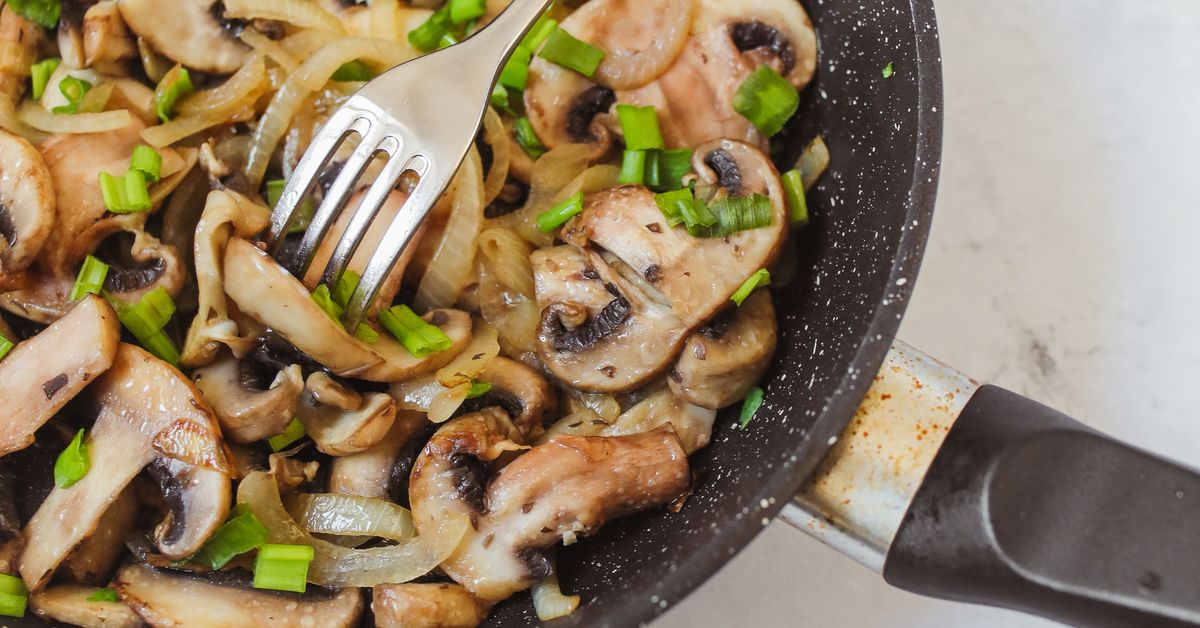
Put the pan on medium-high and get it properly hot before anything goes in. Add the lion's mane with no oil and no butter.
It will look wrong for a minute or two. Then the mushroom starts releasing water, which pools and sizzles. Let it. Keep going until that liquid has cooked off entirely and the pieces have shrunk noticeably and started to firm up. This usually takes four to six minutes and it is the step people skip.
Only now add your fat. Butter, ghee or olive oil, and a generous amount, because the mushroom will drink it. Then leave it alone. Do not stir, do not shuffle the pan. Let one face sit in contact with the metal until it is deeply golden, which takes two to three minutes, then flip once and repeat.
Crowding the pan is the other common failure. Mushrooms released into a crowded pan steam each other. Cook in two batches rather than one if you need to.
Seasoning and what to do with it
Season at the end, not the start. Salt draws moisture out, and adding it early works directly against the dry sear you just spent five minutes on.
Once it is browned, a splash of tamari or soy in the hot pan will be absorbed almost instantly and deepens the umami considerably. Garlic, thyme and a knob of butter in the last thirty seconds is about as far as it needs to go. Black pepper and a squeeze of lemon at the table suit the crab comparison well.
From there it works on toast, folded through pasta, in a risotto, shredded into crab-style cakes, or simply as a side. It takes on flavour readily, so it is forgiving once the texture is right.
What cooking does and does not do
Worth being clear about, since this is a supplement company writing a recipe.
Cooking does something real. Mushroom cell walls are built largely of chitin, which human digestion handles poorly, and heat begins breaking that down. This is why culinary mushrooms are traditionally cooked rather than eaten raw, and it is a genuine reason to cook lion's mane rather than blend it into something.
What cooking does not do is concentrate anything. A pan is not an extraction. The beta-glucan content of a portion of cooked mushroom is what was in the mushroom, and that is a fraction of what a concentrated extract delivers, which we explain in mushroom powder versus extract and beta-glucans explained.
Eat it because it is genuinely excellent food. If you are after the compounds the research focuses on, that is a different product and a different conversation, covered in The Complete Lion's Mane Guide.
Buying and storing fresh lion's mane
Look for clusters that are white to very pale cream, dry to the touch and springy when pressed. Yellowing or browning at the tips means it is past its best, and a slimy or damp feel means it has been stored wet.
Keep it in a paper bag in the fridge rather than plastic, which traps moisture and accelerates spoilage. It holds for about five days to a week. It does not freeze well raw, but it freezes reasonably once cooked.
Frequently asked questions
What does lion's mane taste like when cooked? Mildly savoury and slightly sweet, with a springy shredded texture most people compare to crab or scallop. The flavour is delicate, so it takes on whatever it is cooked with.
Should you wash lion's mane before cooking? No. It is extremely absorbent and will soak up water you then have to cook off. Brush or wipe it with a dry cloth instead.
Why did my lion's mane turn out rubbery? Almost always too much moisture, from washing it, crowding the pan, or adding fat and salt before the water had cooked off. Dry-sear first, then add fat.
Can you eat lion's mane raw? It is better cooked. Mushroom cell walls are largely chitin, which human digestion handles poorly, and heat begins breaking that down. Raw is also unpleasantly spongy.
Does cooking lion's mane destroy its benefits? Cooking helps rather than hurts, since heat breaks down chitin cell walls. What cooking does not do is concentrate anything, so a cooked portion delivers far less of the studied compounds than an extract does.
How do you store fresh lion's mane? In a paper bag in the fridge, not plastic, for about five days to a week. Look for firm white clusters and avoid anything yellowing or slimy.
Sources
National Center for Complementary and Integrative Health. Mushrooms.
Friedman M. Chemistry, Nutrition, and Health-Promoting Properties of Hericium erinaceus Fruiting Bodies and Mycelia and Their Bioactive Compounds. Journal of Agricultural and Food Chemistry.
US Department of Agriculture, FoodData Central. Mushrooms, raw.
These statements have not been evaluated by the Food and Drug Administration. This product is not intended to diagnose, treat, cure, or prevent any disease. Only eat wild mushrooms you have had identified by a qualified expert.


